
The policy underscores a proactive approach to preventing and managing water pollution by ensuring full compliance with liquid waste quality standards and environmental regulations across all campus activities. It integrates technological innovation and sustainable management practices to safeguard aquatic and marine ecosystems from land based pollution sources.
Unpad incorporates the use of Internet of Things (IoT) technology to monitor septic tanks across campus, helping prevent contamination and enabling timely maintenance. Annual water quality assessments are conducted at nine monitoring points on the Jatinangor campus to evaluate biological, chemical, and physical parameters. These include water outlets from wastewater treatment plants (WWTP or IPAL), the check dam, the Unpad basin, and the Sekebitung spring outlet. Monitoring results consistently show values below national quality standards, ensuring that discharged water is safe for the environment.
Additionally, each faculty operates a dedicated wastewater management system (IPAL) to treat liquid waste generated from academic and research activities. Wastewater is categorized as non hazardous and non toxic, and its quality is routinely monitored particularly pH levels to ensure it meets environmental standards before release. This system reflects Unpad’s ongoing commitment to reducing water and marine pollution and maintaining ecosystem safety.
1) Policy of Marine Pollution
In order to realize Unpad as a university that upholds the principles of sustainable water environment management and utilization, the entire academic community is required to play an active role through education, research, and community service programs related to water and environmental sustainability.
Every person responsible for activities that may cause water pollution at Unpad is obliged to prevent it from occurring.
Every person responsible for activities that discharge waste into water bodies must comply with liquid waste and emission quality standards, as well as all relevant environmental regulations.
Liquid and or solid waste generated from operational activities at Unpad must be processed and disposed of in accordance with established waste management facilities and legal provisions.
Rector Regulation of Reduction of water pollution
2) Water Pollution Control in Campus
One of the key technological applications of IoT at Unpad is the monitoring of septic tank levels throughout campus. The system sends alerts when tanks reach a certain capacity, enabling preventive action before leakage or overflow occurs. This ensures that wastewater does not pollute surrounding land or water bodies.
Unpad conducts annual water quality monitoring at nine points across the Jatinangor campus, including wastewater outlet areas, retention basins, and natural springs. Measured parameters biological, chemical, and physical remain below the threshold limits set by national regulations. The results confirm that all processed water is environmentally safe to be discharged into water bodies.
3) Waste Water Management Installation
Every faculty at Universitas Padjadjaran has its own sewage disposal facility (Instalasi Pengelolaan Air Limbah or IPAL). Liquid waste from academic and research activities is channeled to the IPAL for treatment. Only non toxic and non hazardous wastewater is processed through this system. The water quality is monitored by testing several parameters, particularly pH levels, to ensure compliance with environmental standards. Once it meets the required parameters, the treated water is safely discharged or reused.
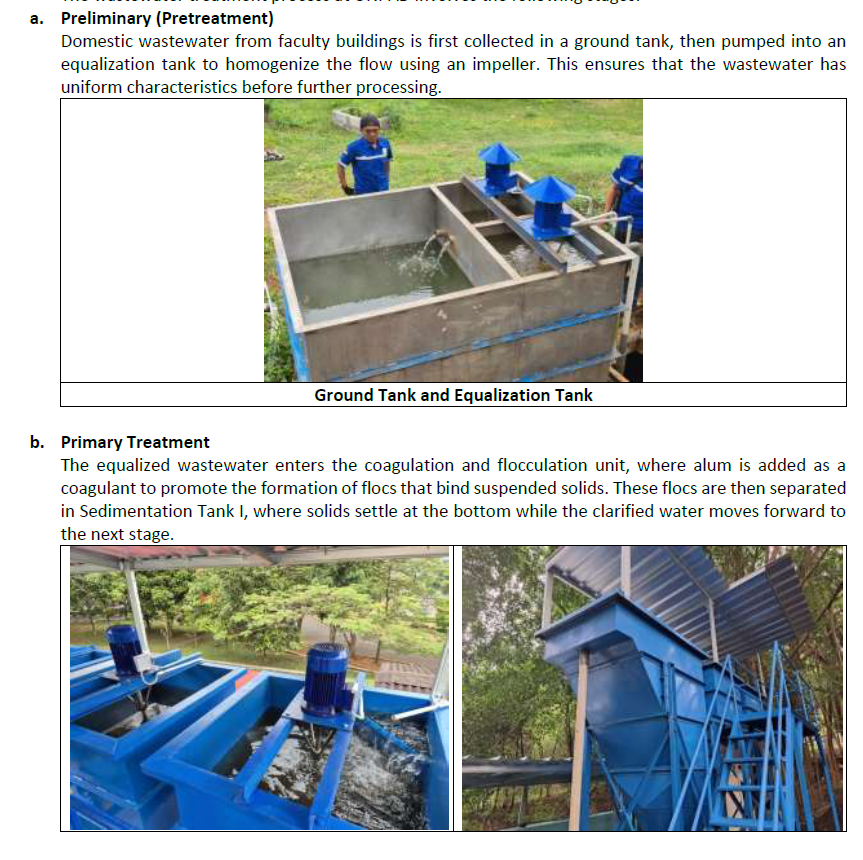
This facility demonstrates Unpad’s strong commitment to preventing water pollution, ensuring that all discharged water is clean, safe, and environmentally sustainable.
Through these integrated measures encompassing preventive policy, technological innovation, and campus wide monitoring, Universitas Padjadjaran ensures effective control of land based pollution sources that may affect marine and freshwater ecosystems. These efforts reinforce Unpad’s commitment to SDG 6 (Clean Water and Sanitation) and SDG 14 (Life Below Water), supporting sustainable water and marine ecosystem protection across all university operations.