
Universitas Padjadjaran (Unpad) has established a Standard Operational Procedure (SOP) for the management and handling of hazardous and toxic waste (B3) to ensure environmental protection and compliance with national safety standards. This SOP regulates the sorting, storage, and disposal of hazardous waste generated from academic, laboratory, and medical activities, supporting Unpad’s broader environmental management framework under the Rector Regulation No. 28 of 2022 on the Reduction of Water Pollution within Universitas Padjadjaran.
Key procedures include:
Sorting: Hazardous waste must be separated and stored according to its type and characteristics (chemical, infectious, pathological, or sharp waste).
Storage duration:
Category A waste: maximum of 90 days.
Category B waste: maximum of 360 days.
Infectious, pathological, and sharps medical waste: maximum of 2 × 24 hours at a temperature above 0°C, and 90 days at a temperature below 0°C.
Storage facilities: Must meet safety standards to prevent leaks, contamination, or exposure to hazardous materials.
Monitoring: Regular inspection and record keeping of waste storage areas are required to ensure compliance and traceability.
This SOP ensures that all hazardous and toxic waste is handled safely, preventing contamination of land and water ecosystems while maintaining occupational health and safety across campus.
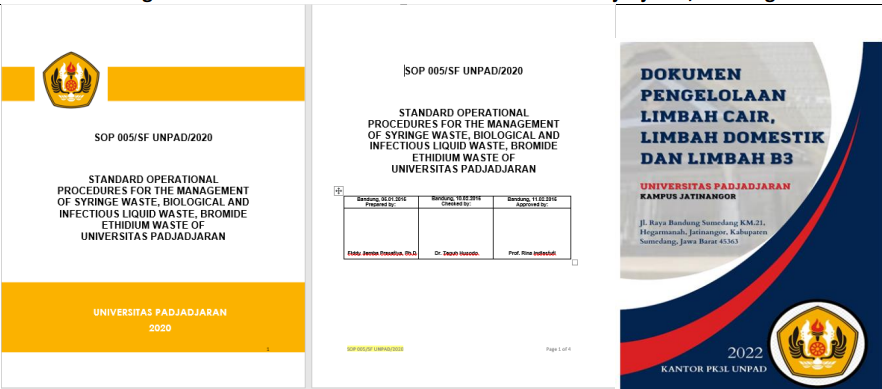
Management of Eco-Friendly Campus at Universitas Padjadjaran
Universitas Padjadjaran integrates eco-friendly campus management into its operations through the implementation of the Eco-Friendly Campus Program, as regulated in the Rector Regulation No. 28 of 2022. The regulation serves as a comprehensive guideline for reducing water pollution, conserving resources, and maintaining the balance of aquatic and terrestrial ecosystems.
The policy aims to minimise physical, chemical, and biological alterations in surrounding environments through sustainable practices aligned with the Green Campus benchmarks, which include:
Security, Safety, Health, and Comfort at Work
a. Air circulation.
b. Ambient air quality.
c. Arrangement of non-smoking areas.
d. Monitoring of greenhouse effects, especially CO₂ and CO.
e. Chemical and natural pollutants.
f. Biological pollutants.
g. Physical comfort.
h. Noise measurement.
i. Adequacy of workspaces.
j. Room lighting quality.
k. Use of personal protective equipment (PPE) when working in high-risk environments.
l. Sanitation system.
Water Conservation
a. Water management policy.
b. Regulation and control of water usage.
c. Efficiency of clean and fresh water usage.
d. Efficiency of water distribution through faucets.
e. Water quality maintenance.
f. Water treatment, recycling, and storage.
g. Water filtration.
h. Reduction in the use and development of deep wells.
i. Implementation of zero runoff and construction of infiltration wells.
j. Conservation and reforestation of water catchment areas.
k. Conservation and maintenance of natural water sources.
These measures, mandated by the Rector Regulation No. 28 of 2022, represent Unpad’s institutional commitment to maintaining ecosystem integrity and preventing environmental degradation through education, research, and responsible campus management. The policy strengthens Unpad’s role as a sustainability-driven university and supports the achievement of SDG 6 (Clean Water and Sanitation), SDG 13 (Climate Action), and SDG 15 (Life on Land).
📄 Reference: