
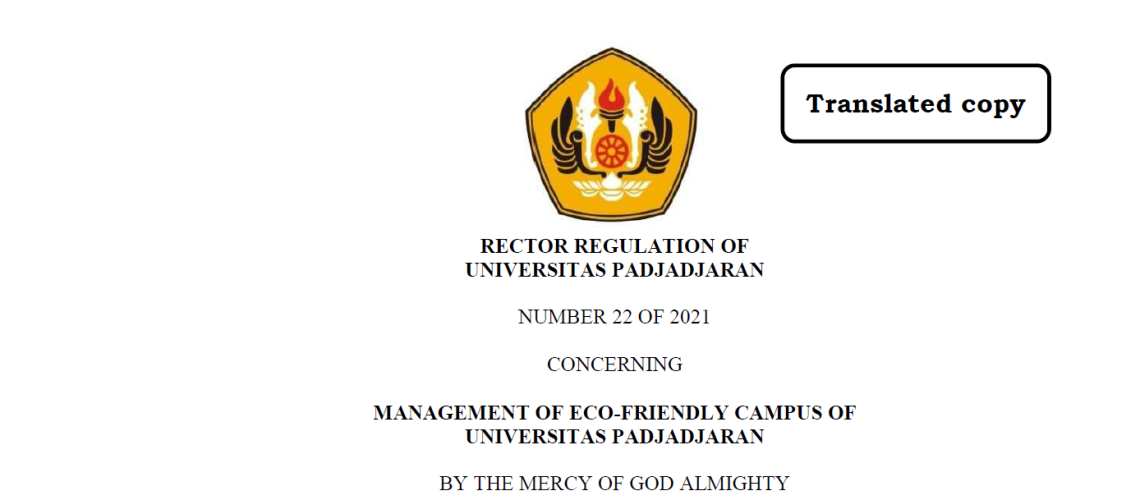
Universitas Padjadjaran aligns its financial, infrastructural, and research priorities with sustainability by avoiding investments in carbon-intensive industries such as coal and oil. This commitment is reinforced by the Rector’s Regulation on Environmentally Friendly Campus Management (No. 3/2022) and the Rector’s Regulation on Green Building, both of which mandate reduced fossil-fuel dependence, energy efficiency, and the integration of environmentally responsible technologies across campus. These regulations guide procurement, development planning, and investment decisions, ensuring that Unpad’s growth supports low-carbon pathways.
Under these policy frameworks, Unpad prioritizes renewable-energy initiatives over fossil-based funding. The Green Building regulation requires the use of natural ventilation, efficient lighting, and smart energy systems, reducing lifetime operational energy and supporting the university’s divestment orientation. Complementing this, Unpad invests in solar power expansion, biogas research, hydro-based systems, and circular-economy innovation. Partnerships such as rooftop solar deployment with PT EMITS and biomass-based energy research further demonstrate the university’s preference for clean-energy solutions.
Unpad’s SDGs Center strengthens this direction through national and international collaboration, including energy-transition research with the Danish Government. These programs support policy development, technical training, and long-term models for clean-energy governance. Together, the environmentally friendly campus regulation, the green building mandate, and Unpad’s expanding renewable-energy portfolio illustrate the university’s institutional alignment with divestment principles. By continuously shifting its investments, infrastructure, and research ecosystem toward renewable and efficient technologies, Unpad demonstrates clear leadership in advancing Indonesia’s transition toward sustainable energy systems.