
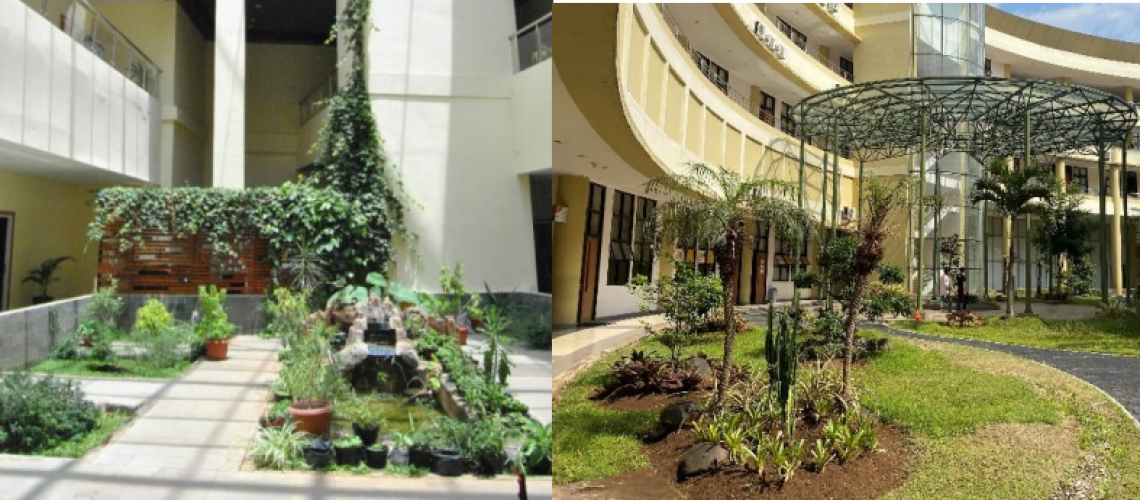
Universitas Padjadjaran is committed to sustainability in its infrastructure development by adhering to sustainable building standards when constructing new buildings. The university ensures that its new facilities are designed and built with eco-friendly materials, energy-efficient systems, and environmentally responsible construction practices.
Universitas Padjadjaran is committed to sustainable development through numerous green building and sustainability initiatives. Unpad has been advancing energy-efficient infrastructure on campus, with a master plan that includes renewable energy sources like solar power and natural ventilation systems to minimize dependence on artificial resources.
In line with this commitment, Universitas Padjadjaran integrates sustainability principles throughout the entire building lifecycle, from planning and design to operation and maintenance. Environmental impact considerations, such as efficient water use, waste reduction, and climate-responsive architecture, are incorporated to ensure long-term environmental performance. The university also promotes green open spaces and landscape management that support biodiversity and improve microclimate conditions across campus. Through these comprehensive efforts, Universitas Padjadjaran reinforces its role as an environmentally responsible institution that aligns infrastructure development with broader sustainability goals and climate action commitments.
Green Building Regulations and Energy Use
Unpad’s green building policies encompass energy planning for efficient and effective use, with a focus on integrating advanced technology. This includes utilizing new and renewable energy sources to support teaching and learning activities, thereby reducing reliance on fossil fuels.
Green Building Principles
Unpad’s green building approach emphasizes the principles of reduce, reuse, and recycle:
- Reduce: Minimize the use of resources, including land, materials, water, and human resources.
- Reuse and Recycle: Incorporate recycled materials and manage waste generation effectively, aiming to minimize both physical and non-physical waste.
- Risk Mitigation: Address safety, health, climate change, and disaster risks through sustainable planning.
Smart Building and IoT Integration
Unpad has adopted Internet of Things (IoT) technology for smart building systems across the campus, which enables data transmission over a network without direct human interaction. Key IoT applications include:
- A/C Monitoring (MONICS): Monitor and manage air conditioning systems for efficient energy use.
- Energy Monitoring: Track energy consumption across various buildings to optimize usage.
- Environmental Monitoring: This encompasses monitoring several environmental aspects, including:
- Water level monitoring
- Air quality monitoring, focusing on carbon dioxide and gases such as smoke and carbon monoxide in indoor areas
- Water quality monitoring for pollutants, presence of lead, and flood water levels

Related links:
Energy and Climate at Unpad,
Green Building at Unpad PDF,
Smart Building Document 1,
Smart Building Document 2