

Universitas Padjadjaran has adopted a formal and enforceable policy to identify, monitor, and protect species included in the International Union for Conservation of Nature (IUCN) Red List and Indonesia’s national conservation lists, particularly those inhabiting areas influenced by the university’s operations. This policy is established through the Rector’s Regulation No. 26 of 2021 on the Conservation of Biological and Non-Biological Resources, which outlines procedures for classifying species as protected or unprotected, conducting regular biodiversity assessments, and implementing conservation measures.
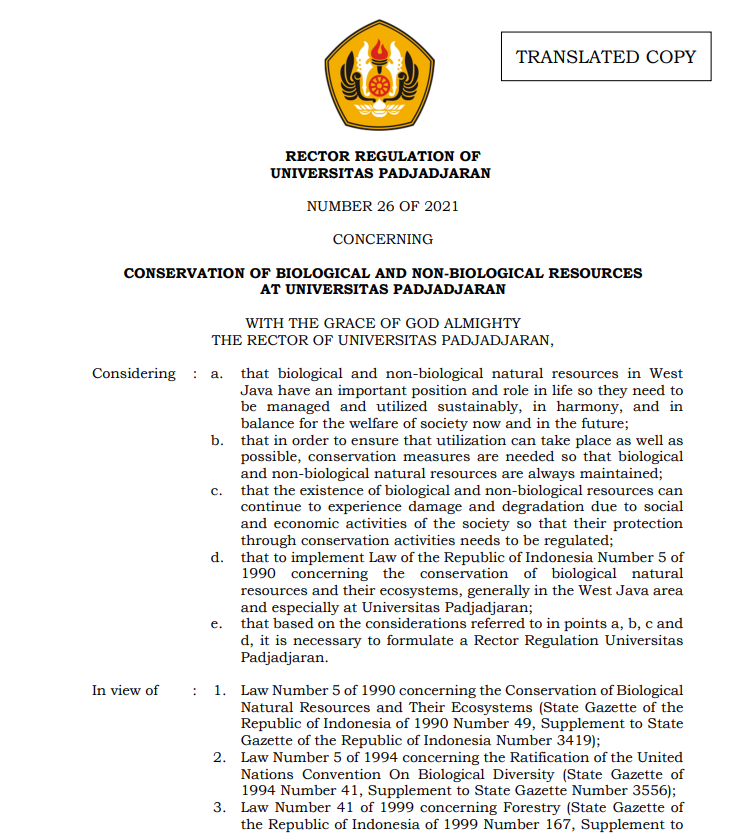
Rector Regulation of IUCN Species
The university routinely carries out Flora and Fauna Inventories through Rector Regulation of IUCN Species to evaluate population status, habitat conditions, and species distribution within and around its managed areas. These monitoring activities are complemented by species identification programs aimed at documenting the presence, health, and ecological roles of various plant and animal species. Conservation initiatives also include habitat restoration, protection of native vegetation, and ex-situ preservation efforts at the Unpad Arboretum and affiliated conservation sites.
All activities are conducted in accordance with national environmental legislation and global biodiversity protection frameworks, ensuring that Unpad’s operations align with both Indonesia’s conservation goals and international standards set by the IUCN. This policy demonstrates the university’s strong commitment to preserving biodiversity, maintaining ecological balance, and minimizing the environmental impact of its academic, research, and community activities.