
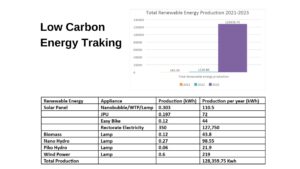
Universitas padjadjaran measures the amount of low carbon energy used across the university. Universitas Padjadjaran has integrated energy efficiency programs that contribute to reducing its environmental impact. These efforts include the use of energy-saving devices, optimizing smart buildings, and reducing paper use. Additionally, Unpad has implemented smart building designs that make use of natural lighting and ventilation systems. The university’s strategies aim to enhance sustainability and manage energy consumption effectively, aligning with broader climate change adaptation initiativesUniversitas Padjadjaran keeps moving forward for using renewable energy. For several years, Universitas Padjadjaran has had two alternative energy sources, i.e. solar panel and biogas. The amount of energy produced from this technology is still far from half usage of Renewable. There is an increasing amount of total energy from solar cells significantly, around 128 mWh/year (see table above). This reflects our strong commitment to sustainability. Our university is dedicated to a greener and more environmentally responsible future, with renewable energy at the forefront of our efforts. Universitas Padjadjaran keeps moving forward to using the Renewable energy. At Universitas Padjadjaran, we’ve achieved a significant milestone in renewable energy. Our biogas and solar panels have generated approximately 128,359.75 kWh, while our total energy demand stands at 4,905,122.34 kWh. This results in a commendable ratio of 2.62%, highlighting our commitment to sustainable energy practices and a greener future. The data presented in the graphic below clearly demonstrates a substantial and noteworthy increase in the ratio of renewable energy sources. This positive trend underscores our unwavering commitment to sustainable and eco-friendly energy solutions.
https://sdgs.unpad.ac.id/wp-content/uploads/2024/11/Low-Carbon-Tracking-2023.pdf
Universitas Padjadjaran has actively engaged in climate change education and outreach, focusing on the risks, impacts, and the importance of mitigation and adaptation strategies. The university’s involvement spans across several local initiatives, including programs that aim to increase awareness of climate change through educational activities that target both students and the wider community. These initiatives contribute to reducing the vulnerability of local populations and enhancing their capacity to adapt to climate risks.
Dissemination and Simulation of Earthquake Disaster Mitigation at SDN 271 Panghegar, Bandung City
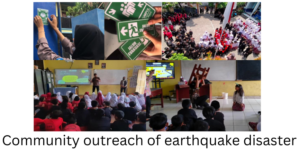
The socialization and simulation of earthquake disaster mitigation carried out for elementary school students aims to form a resilient community in the face of disasters, considering that elementary school students are included in the vulnerable group. Padjadjaran University, through a group of students who conducted community outreach, carried out the Kampus Merdeka activity at SDN 271 Panghegar. This activity was a practice that included providing materials and training in earthquake disaster mitigation simulations.
All students in grades 1 to 6 of SDN 271 Panghegar, totalling 364 students, were involved in this simulation, which took place on November 16, 2023. This event was also held with the support of the Bandung Regency Regional Disaster Management Agency (BPBD). Before the activity began, the team installed evacuation route stickers in the school area to facilitate student movement in the simulation. Each room was guided by two instructors from BPBD and accompanied by homeroom teachers and students. The socialization began with the provision of materials, which included:
- An introduction to disaster signs.
- An explanation of the earthquake process accompanied by animations via projector and video.
- Information on how to access earthquake information and emergency numbers.
- An explanation of steps to protect yourself both indoors and outdoors.
https://ejournal.unma.ac.id/index.php/bernas/article/download/8350/4686/39908
Disaster Mitigation Training
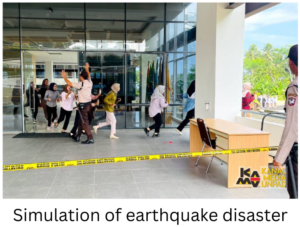
Nursing Study Program students of PSDKU Universitas Padjadjaran in Pangandaran held a simulation of handling an earthquake disaster accompanied by a fire in the campus area on June 8, 2023. This activity was held to increase the academic community’s awareness of PSDKU Unpad Pangandaran regarding the earthquake disaster in the southern coastal area of West Java, which could directly impact the Pangandaran area. In a release received by Kanal Media Unpad, it was stated that the activity was expected to minimize the adverse effects if an earthquake occurs, one of which is a fire that could increase fatalities.
This simulation was carried out in collaboration with the Pangandaran Regency BPBD and related agencies, which are expected to increase collaborative and participatory efforts. In addition, this activity is expected to strengthen the uniqueness of the Nursing Study Program at PSDKU Unpad Pangandaran regarding emergency handling in tourism areas (health tourism and tourism of health).
This disaster simulation was designed with a natural disaster management approach. Of all the participants involved, some participants played the role of victims with red, yellow, green and black triage; became the head of BPBD; became the field coordinator, triage team, evacuation team; handling post team, ambulance team; information team; journalist team; documentation team; security team, and support team. Before this activity, training had been routinely carried out 3 times a week.
Disaster Literacy Program
The Library and Information Science Study Program, Faculty of Communication Sciences, Padjadjaran University, conducted a socialization of disaster literacy and disaster simulations to the community of Jatigede District, Sumedang Regency, on Friday, October 27, 2023. This event aims to increase the understanding, knowledge, and insight of the Jatigede District community, especially government officials and cadres, related to disasters and mitigation efforts. Meanwhile, at SDN Cijeungjing 1, resource persons from the Unpad Library and Information Science study program lecturer Dr Agus Rusmana, MA, taught students how to deal with earthquakes and landslides.
This material is based on the conditions of SDN 1 Cijeungjing, located between hills prone to landslides. On this occasion, participants were given knowledge about various things that need to be done in disaster mitigation, such as what items must be owned and brought when a disaster occurs and knowing the gathering point or safe place. Also presented were the characteristics of earthquakes and landslides and procedures for saving yourself when a disaster occurs.
Weather and Climate Introduction Education to Increase Climate Change Awareness from an Early Age
To raise awareness of climate change from an early age, the community service team from the Department of Marine Affairs, Faculty of Fisheries and Marine Sciences (FPIK) Universitas Padjadjaran (Unpad) held an educational activity at SMPN 2 Rancaekek, Bandung Regency, West Java. The event, held on Wednesday, August 2, 2023, aimed to provide an understanding of weather, climate, and the impacts of climate change to grade 7 students at the school. This activity focused on delivering material on the definition of weather and climate, the impacts of global warming, monitoring climate change, and solutions to reduce its impacts.
In the discussion session, students were invited to actively participate and create environmental campaign slogans as a form of their participation in protecting the environment. By holding this socialization, SMPN 2 Rancaekek can apply the insights they have gained and integrate environmentally friendly habits into daily activities at school. This activity is a real example of the contribution of academics in addressing global environmental issues and building ecological awareness from an early age.
Universitas Padjadjaran is dedicated to promoting environmental sustainability and addressing climate change. The university integrates climate change mitigation and adaptation strategies into its operations, including initiatives focused on energy efficiency, waste management, and sustainability education. Additionally, Unpad actively collaborates with local governments and communities to tackle the impacts of climate change, ensuring a shared commitment to sustainability.
Following up on the Rector Regulation of Universitas Padjadjaran Number 13 of 2022 concerning Green Buildings within Universitas Padjadjaran, as well as an effort to reduce carbon emissions to create a safe, comfortable, and orderly campus environment, Universitas Padjadjaran is committed to working to reduce the impact of climate change on the university environment.
Reducing Carbon Emissions:
- Implement shuttle buses for campus transportation;
- Limit motorized vehicles on campus;
- Restrict official vehicle use;
- Provide electric bicycles as alternatives;
- Designate pedestrian areas;
- Use biogas to reduce LPG reliance.
Reducing Energy Use:
- Require switching off electronics after use;
- Increase solar energy usage by 20% annually;
- Cut electricity consumption by 10% annually;
- Promote energy-saving practices on campus and in the community.
Expanding Green Spaces:
- Install vertical gardens in university buildings;
- Develop campus forests;
- Limit tree cutting for construction;
- Replant trees if removed for development.
In an effort to reduce greenhouse gas production, Universitas Padjadjaran has a replanting program. This planting is carried out in the Universitas Padjadjaran campus area. This planting is also carried out in order to maintain biodiversity, one of which is by planting a collection of bamboo, rare plant species and local fruit plants.
In 2023, several tree planting actions were carried out around various areas, this was done as an effort to increase the water catchment area around the Unpad area. Planting was carried out in Leuwi Padjadjaran Unpad, 500 trees have been planted around this area. In this tree planting effort, Unpad collaborated with various companies including PT Elnusa and PT Grab Indonesia. Tree planting was also carried out through various activities carried out at Unpad. One of them is the National Student Leadership on Sustainability Meeting 2023. In this activity, 30 trees were planted around the Leuwi Padjadjaran area.
https://sdgs.unpad.ac.id/wp-content/uploads/2024/11/Greenhouse_gas_emission_reduction_program.pdf
To reduce energy consumption, the University plans to continue increasing the installation of Renewable Energy installations such as Solar cells and Biogas processing. In addition, the campus focuses on energy-efficiency appliances, such as shifting LED lamps and installing water cloggers. In terms of Green Building design, the University Applies green building concepts, such as natural ventilation, complete natural daylighting, monitoring energy for every building, using efficient energy appliances, etc. This concept is listed in Rector’s Decree No. 13 of 2022.
https://sdgs.unpad.ac.id/wp-content/uploads/2024/11/Elements_of_green_building_implementation.pdf
Universitas Padjadjaran actively participates in cooperative planning for climate change-related disasters, which may involve the displacement of people both within Indonesia and across borders. Through its research and collaboration with government agencies, the university contributes to developing strategies for disaster preparedness, response, and the management of climate-induced migration.
Local wisdom documents for disaster mitigation literacy
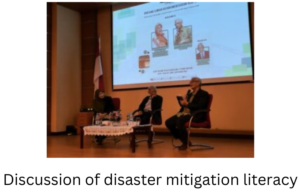
Faculty of Communication Sciences of Padjadjaran University in collaboration with the Indonesian Documentation Study Work (KSKI) organized a scientific talk on documentation series #1 with the theme “Local Wisdom Documents for Disaster Mitigation Literacy”. The activity was held at the Postgraduate Auditorium of Fikom Unpad Jatinangor and was also broadcast live through the Fikom Unpad Official YouTube channel, on Friday, September 8, 2023. Local Wisdom as a Disaster Mitigation Literacy Document: Case Study in Pangandaran Regency” is that local wisdom documents in the form of poetry, badud art traditions, and hajat laut traditions in Pangandaran district are conveying ideas, ideas, expressions of human feelings and thoughts (ancestors) to their communities to achieve a common meaning of religious values, cultural values, and disaster mitigation efforts.
Universitas Padjadjaran plays an active role in informing and supporting local or regional governments in managing climate change-related disasters and risks, particularly in early warning systems and monitoring. The university contributes by conducting research, offering expertise, and developing technologies to enhance disaster preparedness and response.
Disaster study in Natuna Regency
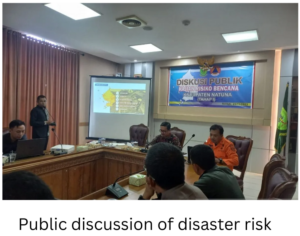
Head of Regional Disaster Management Agency Natuna Regency, Riau Islands, Raja Darmika, said that the local government has collaborated with researchers from Padjadjaran University to study the potential disaster risks in its area. This study is essential for the Natuna Regency Government to understand the types of disasters that may occur and the mitigation steps that can be taken to reduce their impact. Unpad researcher Nour Chaidir also confirmed that he had conducted a study on disaster risks in Natuna.
Based on the data obtained, Natuna has the potential to experience seven types of disasters, such as floods, flash floods, extreme weather, extreme waves and abrasion, forest and land fires, drought, and landslides. “During the three-month study, we found five types of disasters that have high risks, including extreme waves and abrasion, floods, flash floods, forest and land fires, and extreme weather,” he explained. Nour also emphasized that the Natuna Regency Government can minimize the impact of disasters through mitigation. He recommended that the Natuna Regency Government implement appropriate mitigation policies, including strengthening infrastructure to deal with disasters.
Universitas Padjadjaran actively collaborates with various NGOs on climate adaptation initiatives. These partnerships focus on developing and implementing strategies to help communities adapt to the impacts of climate change. Unpad’s collaboration with NGOs includes research, community-based projects, and capacity-building programs.
Plastic Reborn 4.0 Collaboration between Universitas Padjadjaran, Coca-Cola Foundation Indonesia, Ancora Foundation, Parongpong Raw Lab
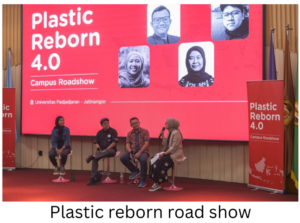
On September 6, 2023, the Plastic Reborn 4.0 Campus Roadshow event was successfully held at Bale Sawala, Universitas Padjadjaran Jatinangor. This event is a collaboration between the Coca-Cola Foundation Indonesia, Ancora Foundation, Parongpong Raw Lab, and the Faculty of Fisheries and Marine Sciences Unpad. Plastic Reborn 4.0 Campus Roadshow is a collaborative effort to raise public awareness, especially the younger generation, about the impact of plastic waste on the environment and Coca-Cola’s latest efforts in maintaining sustainability by releasing R-PET, a beverage bottle made from recycled Coca-Cola Group product bottles.
Plastic Reborn 4.0 Campus Roadshow featured a talk show with sustainability figures: Siska Nirmala from Zero Waste Adventure, Rendy Aditya Wachid from Parongpong Raw Lab, and Andreas Priyo Adianto from the Coca-Cola Foundation Indonesia, who shared about innovations in plastic management and Coca-Cola’s R-PET products. The event also hosted a product exhibition by Conture Concrete Lab, a recycling workshop by Ben Dobbs of PURA, and an empty bottle drop point for recycling participation.
Collaboration with PT. Bukit Raya Sekawan (PT. BRS) to educate disaster mitigation
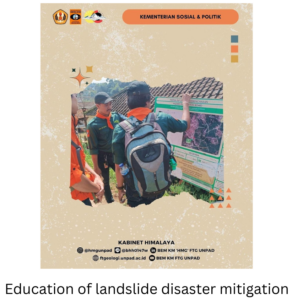
Climate change affects the earth in many ways, including temperature, water quality, rainfall, forests, and agriculture. Banyuresmi Village in Sukasari District, Sumedang Regency, West Java, is affected by climate change. The drainage system in Banyuresmi Village could be improved. Water gets into the soil, making landslides more likely. Landslides are a big problem for the community in this area. Information about large-scale landslides will help people understand the situation and take action to prevent them.
The Community Engagement (PPM) team, which involves students actively engaged in disaster socialization and mitigation, has identified the potential for landslide disasters in Banyuresmi Village from September to December 2023.
https://ftgeologi.unpad.ac.id/raising-awareness-of-landslide-risks-in-banyuresmi-village/
https://www.instagram.com/p/CyTPC8Vp0ha/?igsh=MTVsZHd6bHZpZ3hmag%3D%3D&img_index=7