
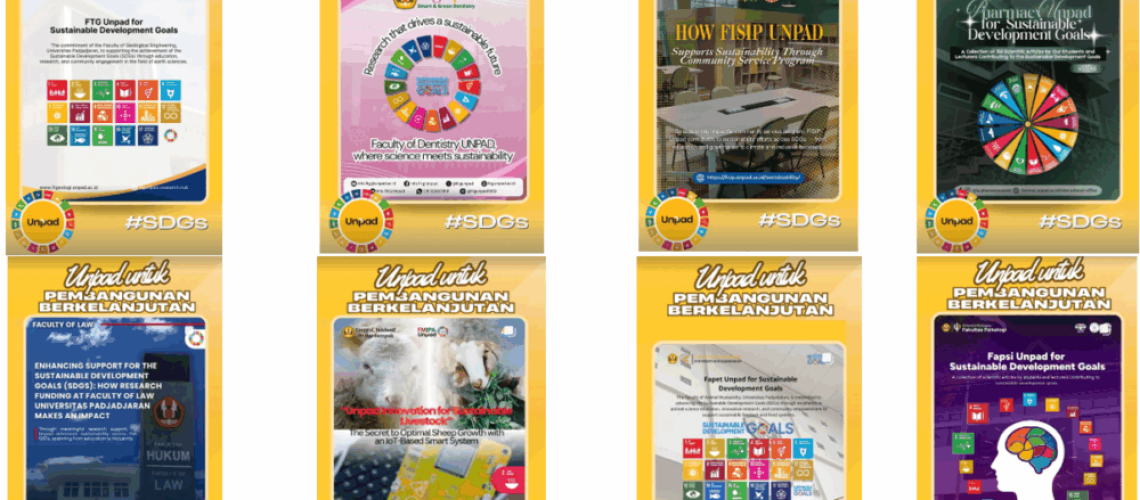
Universitas Padjadjaran demonstrates a strong institutional commitment to advancing the Sustainable Development Goals (SDGs) through education, research, community service, and campus governance. This commitment is formally outlined in the Rector’s Regulation Number 20 of 2024, which provides the strategic foundation for SDG implementation across all levels of the university. The regulation defines the SDGs as a core framework guiding the Tri Dharma of Higher Education which includes education, research, and community service, ensuring that sustainability becomes a driving force in both academic and operational activities.
Rector Regulation Number 20 of 2024 Concerning of Implementation of Achieving Sustainable Development Goals
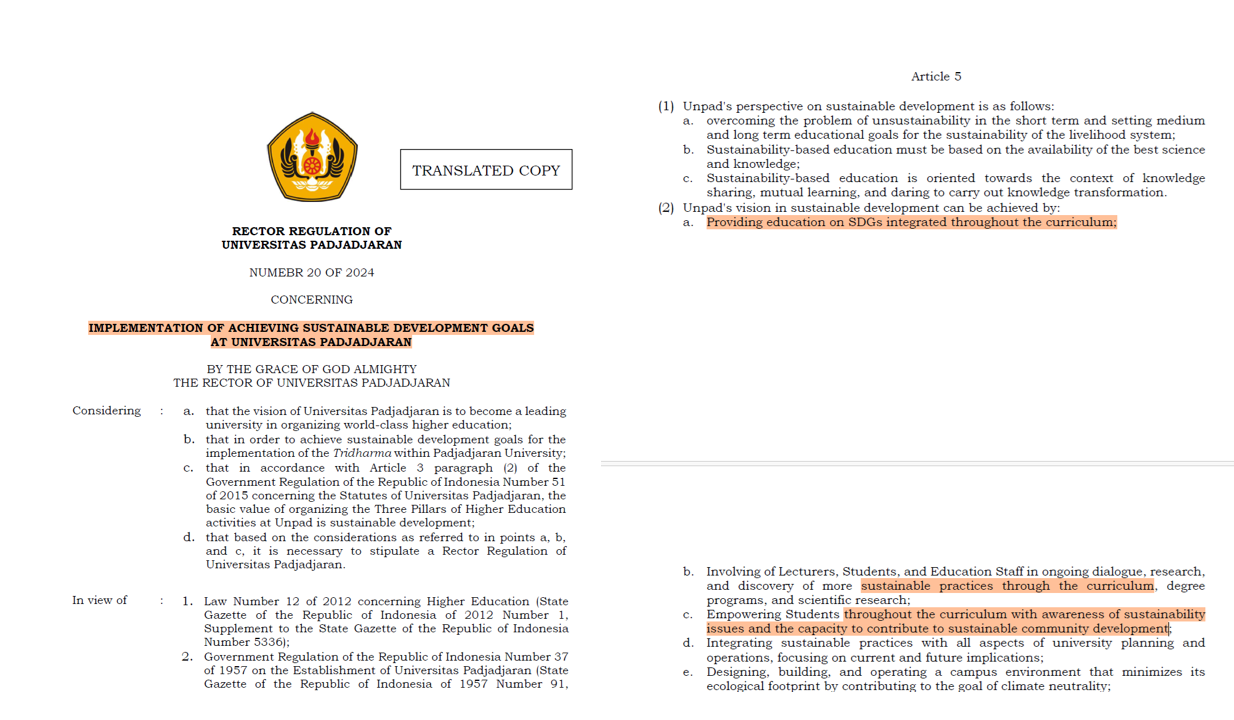
Under this regulation, Article 5 in Rector Regulation of Universitas Padjadjaran Number 20 of 2024 Concerning Implementation of Achieving Sustainable Development Goals at Universitas Padjadjaran emphasizes the integration of SDG education throughout the curriculum. Each academic program is encouraged to embed SDG principles within its courses, enabling students from various disciplines to connect sustainability concepts with real world applications. Student community service projects are also required to address issues aligned with the SDGs, promoting hands on learning and civic engagement. To support this, Universitas Padjadjaran has established sustainability teams at both university and faculty levels to coordinate, implement, and monitor SDG related initiatives.
Universitas Padjadjaran Curriculum Framework
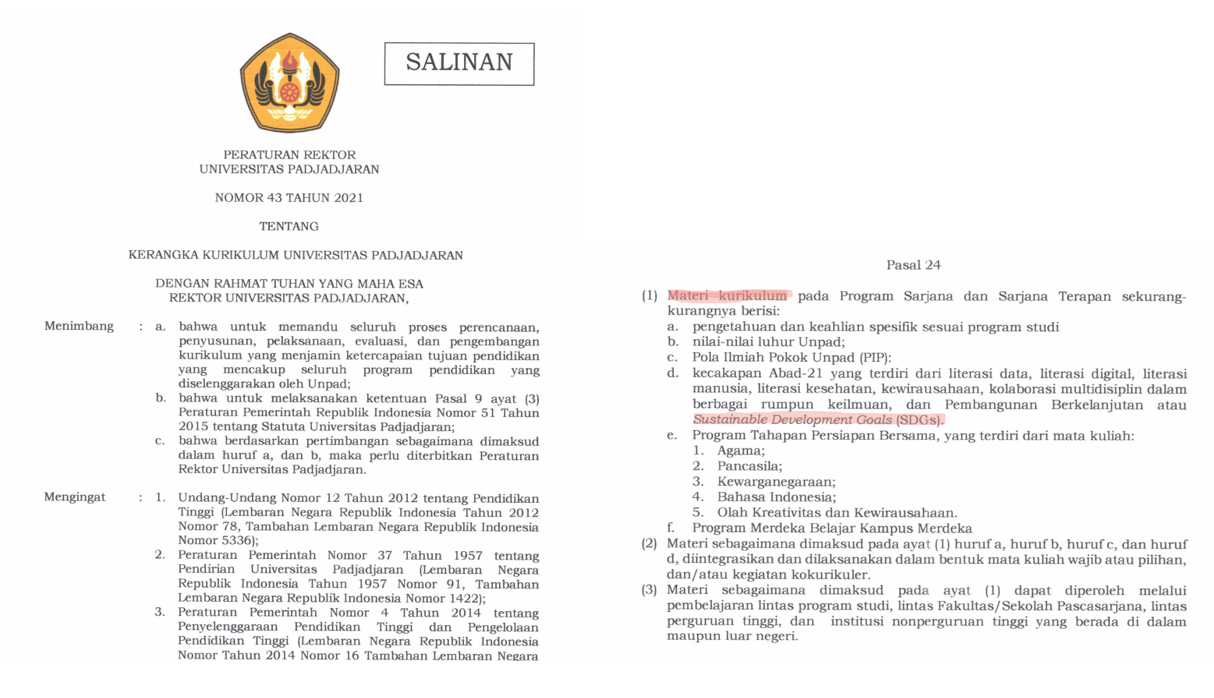
Furthermore, Article 24 of the regulation outlines the Universitas Padjadjaran Curriculum Framework, ensuring that all undergraduate and applied undergraduate programs incorporate sustainability values as part of their core learning content. One of its key components is the integration of Sustainable Development Goals (SDGs) within the university’s 21st century competencies, encouraging students to apply sustainability principles in their academic and professional development.
As part of this framework, Unpad implements the Tahap Persiapan Bersama (TPB) or Joint Preparation Stage, a mandatory curriculum for all first semester undergraduate and applied undergraduate students. The TPB program aims to strengthen students’ analytical and problem solving skills in addressing societal, national, and global challenges based on scientific reasoning and noble values. It also develops essential 21st century skills such as communication, creativity, collaboration, and critical thinking. A key component of this program is TPB SDGs (TPB Sustainable Development Goals), which integrates sustainability and SDG related themes into courses such as Religion, Pancasila, Civics, Indonesian Language, and Creativity and Entrepreneurship (OKK). The OKK course introduces students to Education for Sustainable Development (ESD) and the Sustainable Development Goals (SDGs) through case based learning and project based learning, enabling them to design and implement social action projects that contribute directly to the campus and surrounding communities.
Beyond education, the mainstreaming of SDGs at Universitas Padjadjaran extends to research and community service. Every faculty has implemented SDG tagging across research, innovation, and outreach activities, ensuring that outcomes contribute directly to relevant global goals. This systematic approach allows Unpad to monitor, evaluate, and strengthen its impact toward achieving the 2030 Agenda.
A major milestone in Unpad’s sustainability leadership is the establishment of the SDGs Center Universitas Padjadjaran in 2016, the first of its kind in Indonesia’s higher education sector. The Center serves as a hub for research, policy dialogue, and sustainability education, supporting the integration of SDGs into teaching and institutional activities. All first year students are introduced to SDG concepts through the TPB SDGs program, and student projects are systematically linked to relevant SDG goals.
Through this structured and regulated framework, Universitas Padjadjaran ensures that sustainability is embedded across disciplines and university functions, equipping its academic community with the knowledge, competencies, and values needed to advance the 2030 Agenda for Sustainable Development at local, national, and global levels